
The United States Navy (USN) is the branch of the United States armed forces
responsible for conducting naval operations. Its stated mission is “to maintain,
train and equip combat-ready Naval forces capable of winning wars, deterring
aggression and maintaining freedom of the seas.” The U.S. Navy currently has
over 340,000 personnel on active duty and nearly 148,000 in the Navy Reserve;
it has 277 ships in active service and more than 6,000 operational aircraft. The
United States Navy traces its origins to the Continental Navy, which was
established during the American Revolutionary War and was disbanded shortly
thereafter. The United States Constitution, though, provided the legal basis for a
seaborne military force by giving Congress the power “to provide and maintain
a navy.”Depredations against American shipping by Barbary Coast corsairs
spurred Congress to employ this power by passing the Naval Act of 1794
ordering the construction and manning of six frigates. The U.S. Navy came into
international prominence in the 20th century, especially during World War II.
It was a part of the conflict from the onset of American military involvement
— the Attack on Pearl Harbor — to Japan’s official surrender on the deck of the
USS Missouri. In the subsequent Cold War, the U.S. Navy evolved into a
nuclear deterrent and crisis response force while preparing for a possible
lobal war with the Soviet Union. The 21st century United States Navy maintains
a sizable presence in the world, deploying in such areas as East Asia, Southern
Europe, and the Middle East. Its ability to project force onto the littoral
regions of the world, engage in forward areas during peacetime, and rapidly
respond to regional crises makes it an active player in American foreign and
defense policy.
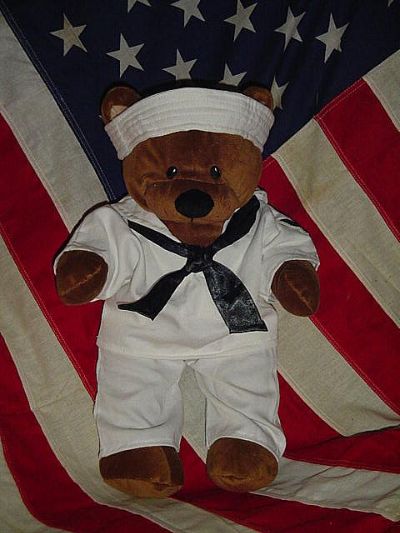
The cost for this special US Navy Bear is only $30 plus S & H.